Showing posts with label URI ATTACK. Show all posts

Friday, 30 September 2016

The global cost of India-Pakistan nuclear war

1475132869-6283.png
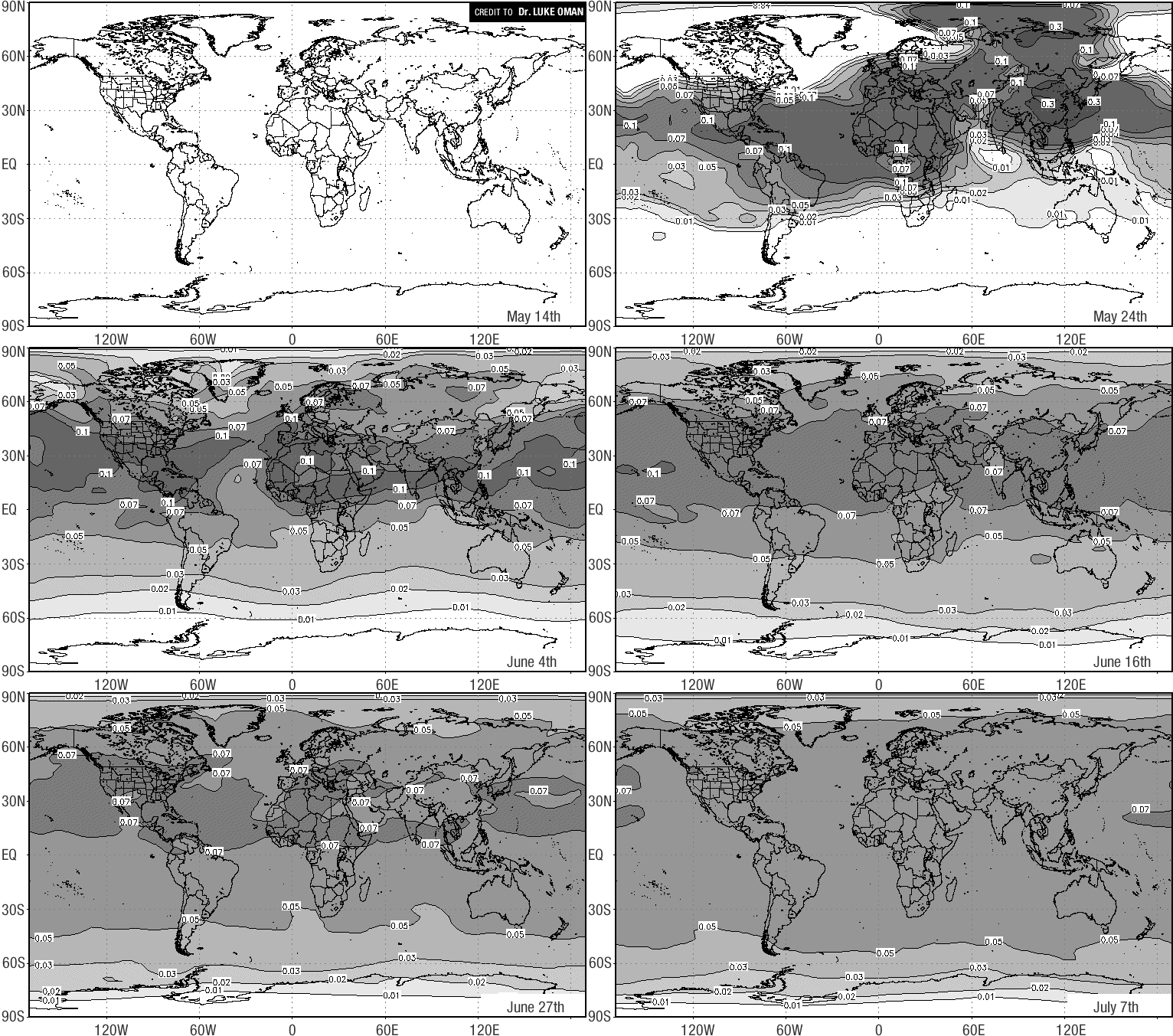
If India and Pakistan fought a war detonating 100 nuclear warheads (around half of their combined arsenal), each equivalent to a 15-kiloton Hiroshima bomb, more than 21 million people will be directly killed, about half the world’s protective ozone layer would be destroyed, and a “nuclear winter” would cripple the monsoons and agriculture worldwide.
As the Indian Army reports striking terrorist camps across the border, and a member of Parliament (MP) of the ruling Bharatiya Janata Party (BJP) urges a nuclear attack and the Pakistan defence minister threatens to “annihilate”India in return, these projections, made by researchers from three US universities in 2007, are a reminder of the costs of nuclear war.
bcabsoptdaily
Visualisation by nucleardarkness.org based on study by researchers from Rutgers University, University of Colorado-Boulder and University of California, Los Angeles
BJP Rajya Sabha MP Subramanian Swamy said, on 23 September, 2016, that if 100 million Indians died in a Pakistani nuclear attack, India’s retaliation would wipe out Pakistan.

pakistans-nuclear-arsenal-desktop
Source: Pakistani Nuclear Forces, 2015; Bulletin of the Atomic Scientists

indias-nuclear-arsenal-desktop
Source: Indian Nuclear Forces, 2015; Bulletin of Atomic Scientists
Agni III, IV and V, with their longer ranges, might be able to reach all of Pakistan, but it can be safely said that they are directed more towards China.
India also possesses an estimated two ship-launched 350-km range Dhanush SRBM, which could be fitted with nuclear warheads.
India’s aircraft can deliver an estimated 45% of 106 warheads. The Indian Air Force’s Jaguar fighter bombers can deliver about 16 nuclear warheads, while the French-built Mirage-2000 fleet can deliver 32.

India strikes across LoC; What are Pakistan's options?

1472031881-7892.jpg
India undertook surgical strikes across the Line of Control, breaching self-imposed military discipline, destroying infrastructure as well as killing terrorists who were poised to cross the border and damage Indian cities and Jammu and Kashmir.

This is bound to invite retaliation, both from Pakistan as well as the rest of world, which will now begin scrambling to plead India to continue its policy of strategic restraint.

The Director General Military Operations (DGMO) used the hotline to contact his counterpart in Pakistan. This is scrupulous observation of protocol – that is exactly what the hotline is for.

The first such interaction is likely on 6 October when Finance Minister Arun Jaitley and Pakistan Finance Minister Ishaq Dar head out to attend the World Bank meeting in the US.

But before that, how will Pakistan respond? That’s what needs to be seen.


1) An unpredictable actor comes into play - a suicide bomber takes it into his head to blow himself up in a crowded place, a Paris type event - which will be the equivalent of tossing a cracker into a crowd and could have unforeseen consequences. 

2) Pakistan retaliates and India hits back, gradually escalating into full scale confrontation.

3)The international community steps in and talks both Pakistan and India out of it. The UNSC holds a meeting and peacemakers step in.

The third scenario is the most likely but the first and second cannot be ruled out.


Related Articles:


Captured soldier inadvertently crossed LoC, report of soldiers killed false: Army

1474467388-4857.jpg
The Indian Army on Thursday said that one of its soldiers from the 37 Rashtriya Rifles (RR), along with his standard weapon, had inadvertently crossed over to the other side of the Line of Control (LoC) and termed as "completely false and baseless" reports in Pakistani media that eight of its soldiers had been killed.

An army release issued by the Defence Ministry said that Pakistan had been informed on the hotline by the Director General Military Operations Lt Gen Ranbir Singh about the soldier crossing over the LoC.

It said that such inadvertent crossing by army personnel and civilians was not unusual on either side and they are are returned through existing mechanisms.

"One soldier from 37 RR with weapon has inadvertently crossed over to the other side of the Line of Control. Pakistan has been informed by the DGMO on the hotline. Such inadvertent crossing by Army and civilians are not unusual on either side. They are returned through existing mechanisms," the release said.

"As regard report of killing of eight Indian Army personnel reported in sections of Pakistan media, the report is completely false and baseless," the release added.

Dawn had quoted security sources as saying that Pakistan military had said it had captured an Indian soldier and killed eight others. Dawn later withdrew the story, replacing it with another that did not specify the number of Indian soldiers killed.

Surgical strikes: How the world conducts them and how India did it

1464334004-7087.jpg
Indian armed forces conducted surgical strikes in the early hours of Thursday across the Line of Control (LoC), involving not more than 100 commandos, in what is seen as a paradigm shift in how this government plans to deal with terrorist camps across the border.

The term "surgical strike" has been prevalent in the international media since the days of the Gulf War, and it came to typify operations conducted by the US thereafter.

Going by the generally accepted definition offered by experts, a surgical strike comprises a swift, intelligence-driven attack on a specific target or targets with minimum collateral damage to structures, infrastructure or civilians in the target's vicinity.

The operation can involve special forces units on the ground, strikes conducted by military aircraft or vessels.


The US and Russia, with varying degrees of success, have been conducting surgical strikes in Syria for some time now, hitting extremists and ISIS targets with PGMs. 
The US in particular has been using its armed drones for targeting specific leaders of various terrorist organisations, especially the al-Qaeda; however, given reports of numerous civilian casualties attached to such strikes, the claims that such operations are surgical strikes have rung hollow for countries like Pakistan and Afghanistan. 

Indian film body bans Pakistani actors

1474609601-8398.jpg
Indian Motion Picture Producers Association on Thursday passed a resolution to ban Pakistani actors from the industry in the wake of the Uri attack.
"IMPPA in their 87th annual general meeting passed a resolution that no Pakistani will be hired by their producer members forever," producer T P Aggarwal, the president of IMPPA, told PTI.
The resolution came on a day the Indian Army announced that seven terror launch pads were targeted across the Line of Control by special forces during a 'surgical strike' overnight in which heliborne and ground forces were used.
Producer Ashoke Pandit, a member of the IMPPA, said, "IMPPA paid homage to the martyrs who were killed in Uri. It therefore felt its responsibility towards the nation and passed a resolution banning Pakistani Actors & technicians in India till normalcy returns. For IMPPA, nation comes first."
18 Army personnel were killed in the Uri attack.
The decision came amid demands by various political outfits to ban Pakistani artistes from Indian films and performing in India.
Last week, Raj Thackeray  led  Maharashtra Navanirman Sena issued a 48-hour ultimatum to Pakistani artistes and actors including Fawad Khan and Ali Zafar, to leave India by September 25 or else they would be pushed out.
Recently, the concerts of Pakistani singers Shafqat Amanat Ali and Atif Aslam scheduled in Bengaluru and Gurgaon respectively were also cancelled.

Friday, 23 September 2016

Nawaz Sharif's UNGA speech: Top 10 things he said and India's rebuttals to his accusations

1474469466-4263.jpg
Pakistan Prime Minister Nawaz Sharif raked up the Kashmir issue at the UN General Assembly on Wednesday and tried to burnish his country's credentials as an opponent of global terrorism.
His speech, which also referred to the prevailing situation in Europe and the Middle East, attempted to paint India as an uncooperative neighbour which had rebuffed Sharif's overtures for peace.
His speech came days after suspected Pakistan-based terrorists attacked an Indian army camp in Uri, in Kashmir, and killed 18 Indian soldiers. The four terrorists who participated in the attack were also eliminated by the security forces during the attack.
1) Describing Burhan Wani, the Hizb-ul-Mujahideen commander who was killed in an encounter with security forces on July 8, as a "young leader", Sharif said that he had emerged as a "symbol of the latest Kashmiri Intifada" after he was "murdered" by security forces.
India's Minister of State for External Affairs M J Akbar responded to Sharif's description of Wani by saying that what India saw was "... the glorification of a terrorist. Wani is declared commander of Hizbul, widely acknowledged as a terror group. It is shocking that a leader of a nation can glorify a self-advertised terrorist at such a forum. This is self incrimination by Pakistan PM."
2) Sharif said that Pakistan wanted peace with India and that he had gone "the extra mile" to achieve that aim. He added that he had repeatedly made offers for a dialogue "to address all outstanding issues".
India rejected Sharif's call for sustained dialogue, with Akbar saying that Islamabad was talking about dialogue with a "gun in its hand".
3) Insisting that resolving the Kashmir dispute was essential for peace between Pakistan and India and that dialogue was necessary for that process, Sharif alleged that India was posing "unacceptable preconditions" before being willing to participate in a read full story 


Related Articles:
Nawaz Sharif gone beyond all shame by calling 'terrorist a leader': R K Singh

Tuesday, 20 September 2016

Post-Uri attack, Salman Khurshid hopes Modi Govt.will go beyond words

1474288369-2169.jpg

Kashmiri activist Sushil Pandit has urged that India must not observe restraint and seek retribution against Pakistan for Sunday's terror strike in Uri.

Pandit said, "This attack merits a very serious retaliation from the government. India must no longer observe the restraint that it has shown over the past so many decades. Pakistan does not merit Indian restraint anymore.
This toll is likely to go higher because there are several injured soldiers in critical condition. The coffins have begun to reach their families. This nation wants retribution."

India is to present all actionable evidence against Pakistan if required at international bodies.

Sources state that External Affairs Minister Sushma Swaraj will strongly emphasise on Pakistan's involvement in the attack in her UNGA speech on September 26.

Pakistan has, however, flatly refused New Delhi's claims of Islamabad's involvement in the Uri terror attack, stating that it has become India's traditional tendency to point fingers on them after each read full story


Related Articles:


Monday, 19 September 2016

17 soldiers killed, 23 injured in cross-LoC strike on Uri camp

1474203726-2889.jpg
In a jarring challenge to the army in Jammu & Kashmir(J&K), armed militants attacked a camp near the border town of Uri on Sunday morning, killing 17 soldiers and wounding another 23. This is the heaviest blow the army has suffered in a single attack since armed insurgency broke out in J&K in 1990.

Lt Gen Ranbir Singh, the army’s Director General of Military Operations (DGMO), described the events in a media statement. He said a group of Pakistani terrorists attacked the camp at 5.30 am and four were killed by 8.30 am. It remains unclear whether there were more. Explaining the heavy army casualties, the DGMO said: “The terrorists fired incendiary ammunition, along with automatic fire of small arms that led to army tents [and] temporary shelters catching fire… There have been a total of 17 army fatal casualties. Of these, 13-14 casualties have been due to these tents/shelters having caught fire.”
The administrative echelons of two infantry battalions — 10 DOGRA and 6 BIHAR — were in the camp. Their combat echelons had deployed in forward posts along the line of control (LoC), leaving the camp lightly guarded.

Even so, the attack raises serious questions of operational culpability. An infantry battalion’s administrative echelons should also consist of armed and trained soldiers, who should not have been caught napping by a read full story

Related stories: