Showing posts with label SURGICAL STRIKE. Show all posts

Thursday, 28 June 2018

Watch Video: Surgical strike video released, shows ops against terror camps

On September 29, 2016, the Indian Army announced that it attacked terrorists' camps along the Line of Control using ground forces.

 surgical strike
 

Surgical Strike Purported visuals of the Indian Army's cross-border operations against terrorists about two years ago were broadcast by television channels on Wednesday night. 


News channels said the grainy footage on air showed gunfire and explosions targeting enemy camps in Pakistan-occupied Kashmir, an operation that came in retaliation to a terrorist strike on an Indian Army camp and is widely known as surgical strikes.


The reports also said these videos, provided to TV channels by sources, were shot by drones using thermal imaging cameras. Business Standard could not independently verify the authenticity of the videos but an official who was directly in charge of the operation confirmed that they were real.


“When the surgical strikes happened, my view was that the videos should have been released as proof. It is good that they have come out now,” Lt General D S Hooda (retd) told The Indian Express.


On September 29, 2016, the Indian Army announced that it attacked terrorists' camps along the Line of Control using ground forces. The act, which officials said inflicted “significant casualties” on terrorists, came after a deadly attack on a military base in Uri in Jammu and Kashmir on September 18 that year.


Pakistan rejected India's claims of having launched a surgical strike on terrorist camps in Pakistani territory. In a book launched on the first anniversary of surgical strikes, an Army Major, who reportedly led the mission, said the return was the most difficult part and bullets fired by the enemy were so close that these were whistling past the ears.


The officer, referred to as Major Mike Tango, said in the book,"The target list was scrutinised along a top-secret chain of command that numbered barely a handful of people, with 'need to know' rules applicable throughout.

Watch → Surgical Strike Video

Friday, 30 September 2016

The global cost of India-Pakistan nuclear war

1475132869-6283.png
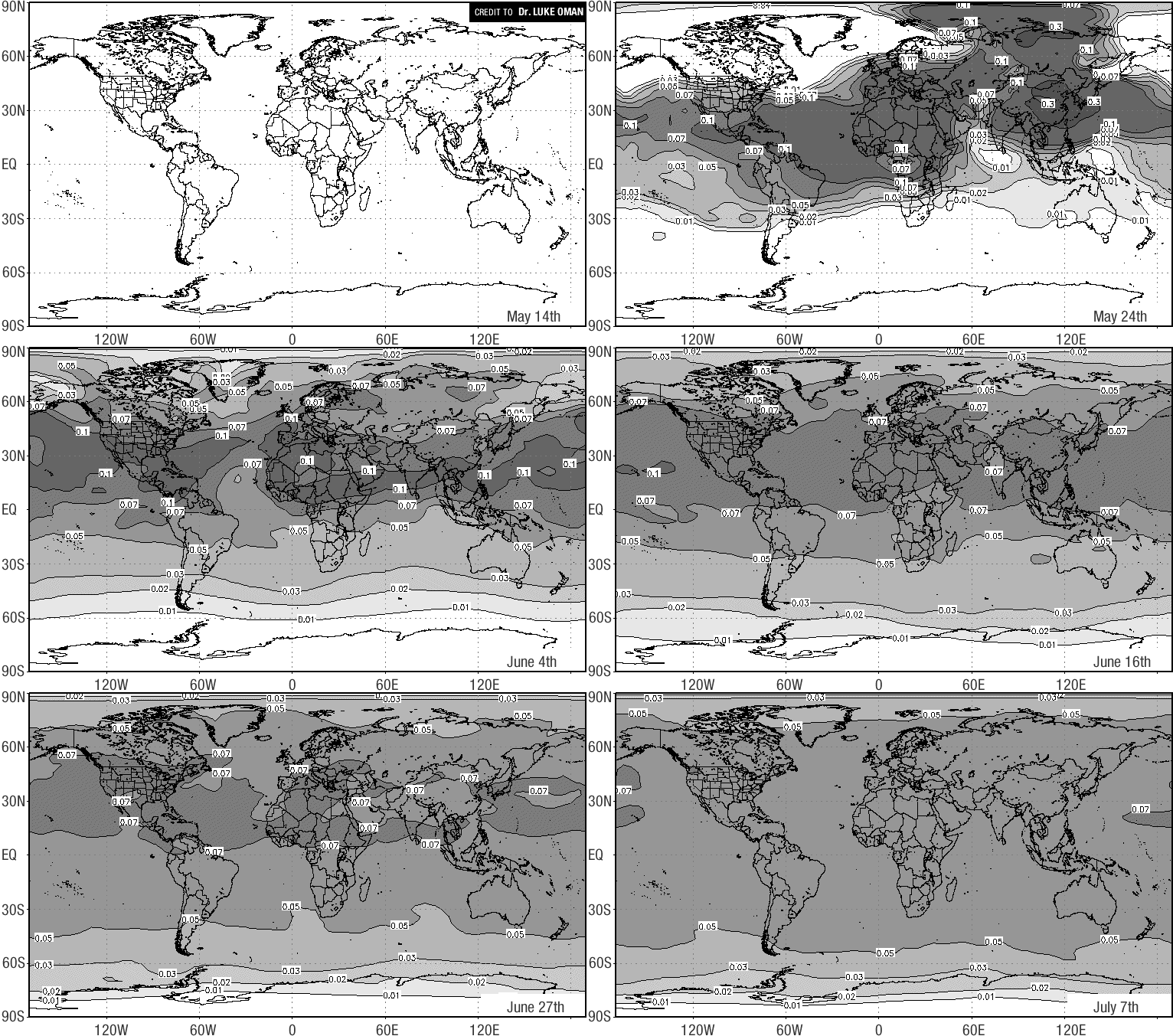
If India and Pakistan fought a war detonating 100 nuclear warheads (around half of their combined arsenal), each equivalent to a 15-kiloton Hiroshima bomb, more than 21 million people will be directly killed, about half the world’s protective ozone layer would be destroyed, and a “nuclear winter” would cripple the monsoons and agriculture worldwide.
As the Indian Army reports striking terrorist camps across the border, and a member of Parliament (MP) of the ruling Bharatiya Janata Party (BJP) urges a nuclear attack and the Pakistan defence minister threatens to “annihilate”India in return, these projections, made by researchers from three US universities in 2007, are a reminder of the costs of nuclear war.

bcabsoptdaily
Visualisation by nucleardarkness.org based on study by researchers from Rutgers University, University of Colorado-Boulder and University of California, Los Angeles
BJP Rajya Sabha MP Subramanian Swamy said, on 23 September, 2016, that if 100 million Indians died in a Pakistani nuclear attack, India’s retaliation would wipe out Pakistan.

pakistans-nuclear-arsenal-desktop
Source: Pakistani Nuclear Forces, 2015; Bulletin of the Atomic Scientists

indias-nuclear-arsenal-desktop
Source: Indian Nuclear Forces, 2015; Bulletin of Atomic Scientists
Agni III, IV and V, with their longer ranges, might be able to reach all of Pakistan, but it can be safely said that they are directed more towards China.
India also possesses an estimated two ship-launched 350-km range Dhanush SRBM, which could be fitted with nuclear warheads.
India’s aircraft can deliver an estimated 45% of 106 warheads. The Indian Air Force’s Jaguar fighter bombers can deliver about 16 nuclear warheads, while the French-built Mirage-2000 fleet can deliver 32.

India strikes across LoC; What are Pakistan's options?

1472031881-7892.jpg
India undertook surgical strikes across the Line of Control, breaching self-imposed military discipline, destroying infrastructure as well as killing terrorists who were poised to cross the border and damage Indian cities and Jammu and Kashmir.

This is bound to invite retaliation, both from Pakistan as well as the rest of world, which will now begin scrambling to plead India to continue its policy of strategic restraint.

The Director General Military Operations (DGMO) used the hotline to contact his counterpart in Pakistan. This is scrupulous observation of protocol – that is exactly what the hotline is for.

The first such interaction is likely on 6 October when Finance Minister Arun Jaitley and Pakistan Finance Minister Ishaq Dar head out to attend the World Bank meeting in the US.

But before that, how will Pakistan respond? That’s what needs to be seen.


1) An unpredictable actor comes into play - a suicide bomber takes it into his head to blow himself up in a crowded place, a Paris type event - which will be the equivalent of tossing a cracker into a crowd and could have unforeseen consequences. 

2) Pakistan retaliates and India hits back, gradually escalating into full scale confrontation.

3)The international community steps in and talks both Pakistan and India out of it. The UNSC holds a meeting and peacemakers step in.

The third scenario is the most likely but the first and second cannot be ruled out.


Related Articles:


Captured soldier inadvertently crossed LoC, report of soldiers killed false: Army

1474467388-4857.jpg
The Indian Army on Thursday said that one of its soldiers from the 37 Rashtriya Rifles (RR), along with his standard weapon, had inadvertently crossed over to the other side of the Line of Control (LoC) and termed as "completely false and baseless" reports in Pakistani media that eight of its soldiers had been killed.

An army release issued by the Defence Ministry said that Pakistan had been informed on the hotline by the Director General Military Operations Lt Gen Ranbir Singh about the soldier crossing over the LoC.

It said that such inadvertent crossing by army personnel and civilians was not unusual on either side and they are are returned through existing mechanisms.

"One soldier from 37 RR with weapon has inadvertently crossed over to the other side of the Line of Control. Pakistan has been informed by the DGMO on the hotline. Such inadvertent crossing by Army and civilians are not unusual on either side. They are returned through existing mechanisms," the release said.

"As regard report of killing of eight Indian Army personnel reported in sections of Pakistan media, the report is completely false and baseless," the release added.

Dawn had quoted security sources as saying that Pakistan military had said it had captured an Indian soldier and killed eight others. Dawn later withdrew the story, replacing it with another that did not specify the number of Indian soldiers killed.

Surgical strikes: How the world conducts them and how India did it

1464334004-7087.jpg
Indian armed forces conducted surgical strikes in the early hours of Thursday across the Line of Control (LoC), involving not more than 100 commandos, in what is seen as a paradigm shift in how this government plans to deal with terrorist camps across the border.

The term "surgical strike" has been prevalent in the international media since the days of the Gulf War, and it came to typify operations conducted by the US thereafter.

Going by the generally accepted definition offered by experts, a surgical strike comprises a swift, intelligence-driven attack on a specific target or targets with minimum collateral damage to structures, infrastructure or civilians in the target's vicinity.

The operation can involve special forces units on the ground, strikes conducted by military aircraft or vessels.


The US and Russia, with varying degrees of success, have been conducting surgical strikes in Syria for some time now, hitting extremists and ISIS targets with PGMs. 
The US in particular has been using its armed drones for targeting specific leaders of various terrorist organisations, especially the al-Qaeda; however, given reports of numerous civilian casualties attached to such strikes, the claims that such operations are surgical strikes have rung hollow for countries like Pakistan and Afghanistan. 

Indian film body bans Pakistani actors

1474609601-8398.jpg
Indian Motion Picture Producers Association on Thursday passed a resolution to ban Pakistani actors from the industry in the wake of the Uri attack.
"IMPPA in their 87th annual general meeting passed a resolution that no Pakistani will be hired by their producer members forever," producer T P Aggarwal, the president of IMPPA, told PTI.
The resolution came on a day the Indian Army announced that seven terror launch pads were targeted across the Line of Control by special forces during a 'surgical strike' overnight in which heliborne and ground forces were used.
Producer Ashoke Pandit, a member of the IMPPA, said, "IMPPA paid homage to the martyrs who were killed in Uri. It therefore felt its responsibility towards the nation and passed a resolution banning Pakistani Actors & technicians in India till normalcy returns. For IMPPA, nation comes first."
18 Army personnel were killed in the Uri attack.
The decision came amid demands by various political outfits to ban Pakistani artistes from Indian films and performing in India.
Last week, Raj Thackeray  led  Maharashtra Navanirman Sena issued a 48-hour ultimatum to Pakistani artistes and actors including Fawad Khan and Ali Zafar, to leave India by September 25 or else they would be pushed out.
Recently, the concerts of Pakistani singers Shafqat Amanat Ali and Atif Aslam scheduled in Bengaluru and Gurgaon respectively were also cancelled.

5 key events that will drive the markets from here on

1440532895-0777.jpg

After a knee-jerk reaction to the surgical strike by India across the Line of Control (LoC) that saw the S&P BSE Sensex tumble over 500 points in intra-day deals on Thursday, the markets remained on the edge on Friday. The S&P BSE Sensex and the Nifty 50 indices lost ground after opening on a flat note.

Analysts expect markets to remain choppy as investors adopt a wait-and-watch mode over the next few sessions till there is more clarity on the geopolitical situation.


Besides the second quarter results of India Inc, here are 5 key factors that will determine the market direction over the next couple of months.

Clarity on the geopolitical situation...

RBI Monetary Policy review...

US Presidential Election...

Rate hike by the US Fed...

Oil Prices...


Related Articles:

Behind Pakistan's military confidence: China's growing shadow

1469180452-4907.jpg
Until five years ago, the USA and China shared an almost equal proportion of Pakistan’s arms imports: 39% and 38% respectively. Today, China supplies 63% of Pakistan’s armaments, with the USA dropping to 19% and second place, an India Spend analysis reveals, as Pakistan mulls a response to India’s strike on terror camps across the border.
China’s rise to becoming the world’s third-largest arms exporter was to a large degree helped by heightened demand from Pakistan, which now buys 35% of these exports and is Beijing’s biggest buyer (Bangladesh follows at 20%), according to this February 2016 report from the Stockholm International Peace Research Institute (SIPRI).
The military supplies are bolstered by unwavering support at a time of heightened tension with India and faltering ties with the US (there was a 73% drop in US security aid over four years to 2015,The Wire reported in August 2016; the US also cancelled the subsidised sale of eight F-16 fighter jets).
 
Source: Stockholm International Peace Research Institute Link 1 & Link 2
Last month, Pakistan’s ministry of defence production confirmed a contract with China for the purchase of eight conventional diesel-electric submarines, which will cost between $4 billion to $5 billion (Rs. 25,600 crore to Rs. 33,200 crore), China’s biggest defence export deal.
From 2011 to 2015, China sold $8.4 billion worth of arms, overtaking long-established arms exporters France ($8 billion) and Germany ($6.7 billion), although it still lags the leaders: the US ($47 billion) and Russia ($36.2 billion).
Stockholm International Peace Research Institute, Figures in million US$ at constant 1990 prices